
Agentic AI vs Generative AI: Key Differences Every Builder Should Know
You set up ChatGPT to "automate" your content workflow last month. It worked for drafts. Then you asked it to research three competitors, compile findings into a comparison table, and publish the post to your site — and it confidently invented revenue numbers, returned code that wouldn't run, or handed back a draft that still needed an hour of manual assembly before it was usable. The realization hits fast: the tool was never built to do the work. It was built to write about the work.
That gap — between drafting and doing — is what separates generative AI from agentic AI. And it's why solopreneurs, sales teams, and ecommerce operators are suddenly asking which one they actually need. The agentic AI vs generative AI question isn't academic anymore. It maps directly to whether you spend tomorrow morning copy-pasting between five tabs or reviewing a finished file that an agent already committed to your repo.
This post answers two things: when does generative AI stop being enough, and what specifically does agentic AI add that justifies switching workflows?

Table of Contents
- What Generative AI Was Actually Built to Do (And Where It Stalls)
- The Five Capabilities Agentic AI Adds on Top
- When You Actually Need Agentic AI vs When Generative AI Is Enough
- Inside an Agentic AI Loop — How Autonomous Execution Actually Works
- Speed, Cost, Control, and Privacy — The Real Tradeoffs
- The Three-Question Test for Picking the Right AI for Your Next Project
What Generative AI Was Actually Built to Do (And Where It Stalls)
Generative AI is not broken. It's fit for a narrower purpose than most builders assume — and confusing that purpose with "an AI that runs your business" is what burns weekends.
Mechanically, generative AI is a stateless, single-step request-response service. You provide a prompt, the model performs one inference pass to produce content, then stops. According to Red Hat, generative AI "typically performs inference once" to create output like a paragraph, an image, or a code snippet. There is no loop. There is no follow-up. The model does not check its own answer, does not call an API, does not save what it just wrote anywhere. It outputs, then waits for the next prompt.
What it excels at, then, is exactly what that architecture supports: synthesis, drafting, ideation, summarization, rewriting, translation. Thomson Reuters frames generative AI's sweet spot as "discrete, single tasks" — drafting an email, summarizing a document, generating variations of a headline. Coursera's mental model is even cleaner: generative AI generates. That's the whole job.
The economic story behind why this matters is enormous. McKinsey estimates generative AI could add USD 2.6–4.4 trillion in annual economic value across 63 use cases spanning banking, retail, manufacturing, and customer operations. Goldman Sachs Research projects a 1.5 percentage point lift in annual global labor productivity growth and up to a 7% increase in global GDP over a 10-year adoption window. Generative AI is not going away. It solves one slice of the problem extremely well.
Generative AI is a creativity co-pilot, not an operations co-worker — and the moment your task has more than one step, you feel it.
But "one slice" is the key phrase. Three structural limits keep generative AI from doing your actual work:
- No persistent memory beyond the context window. Each session starts fresh. The model does not remember the prospect list you uploaded last Tuesday, the brand voice rules you spent an hour refining, or the fact that you already drafted this exact email two weeks ago. Infor flags limited memory as one of generative AI's defining constraints.
- No native control loop. It outputs once, regardless of whether the output is wrong. If the model hallucinates a statistic in paragraph two, it won't notice and self-correct in paragraph three. It cannot retry, reroute, or escalate.
- No tool access. It can describe an API call in convincing detail but cannot make one. It can write a SQL query but cannot execute it. It can draft a Slack message but cannot send it.
Here's the failure pattern in practice. ChatGPT can draft a perfect cold email to a prospect — punchy subject line, clean opener, soft CTA. What it cannot do, in the same session, without you babysitting every step: verify the prospect still works at the company, pull their current LinkedIn headline, check whether you already emailed them this quarter, score the lead against your ICP, log the touch in your CRM, or actually send the email through your sequencer. Every step except the draft falls to you. You become the orchestration layer. You are the glue holding the workflow together — and you are also the bottleneck.
This is why solo creators and small teams hit a ceiling fast with generative AI alone. The drafts are great. The drafts are also where the help ends. Everything between "I have a great draft" and "the work is done" is still manual, and that everything is usually 70% of the hours.
The question isn't whether generative AI works. It does, brilliantly, for what it was built for. The question is what fills the gap between draft and done — and that's where agentic AI enters the conversation. The underlying models powering these tools are the same; the architecture wrapped around them is what changes.
The Five Capabilities Agentic AI Adds on Top
Agentic AI doesn't replace generative AI. It wraps it. Multiple sources confirm agentic systems are built on top of generative models, calling LLMs internally for reasoning while adding goal-direction, tool use, and memory around them. Exabeam summarizes the relationship: "Agentic AI makes decisions and takes actions, while generative AI primarily focuses on content generation." What follows are the five capabilities that wrapper adds.
1. Autonomous Task Decomposition
An agent receives a goal — not a prompt — and splits it into sub-steps without human re-prompting. "Find 50 B2B SaaS leads in Toronto with verified emails" becomes a sequence: search relevant companies → filter by criteria → scrape contact data → validate emails → deduplicate against your existing CRM → format the CSV. IBM describes this as agentic AI's "proactive" behavior versus generative AI's reactive prompt-response pattern. You set the destination. The agent picks the route.
2. A Plan–Act–Observe–Learn Loop
Instead of one inference pass, agentic systems run multiple inferences in a loop: plan a step, execute it, evaluate the result, retry or move on. Red Hat describes inference running "multiple times inside a loop" to plan, act, and self-correct during a workflow. Generative AI has no equivalent. It cannot notice its own mistake mid-output. An agent can — and that single architectural difference is why agents finish tasks that generative AI only describes.
3. Tool and API Execution
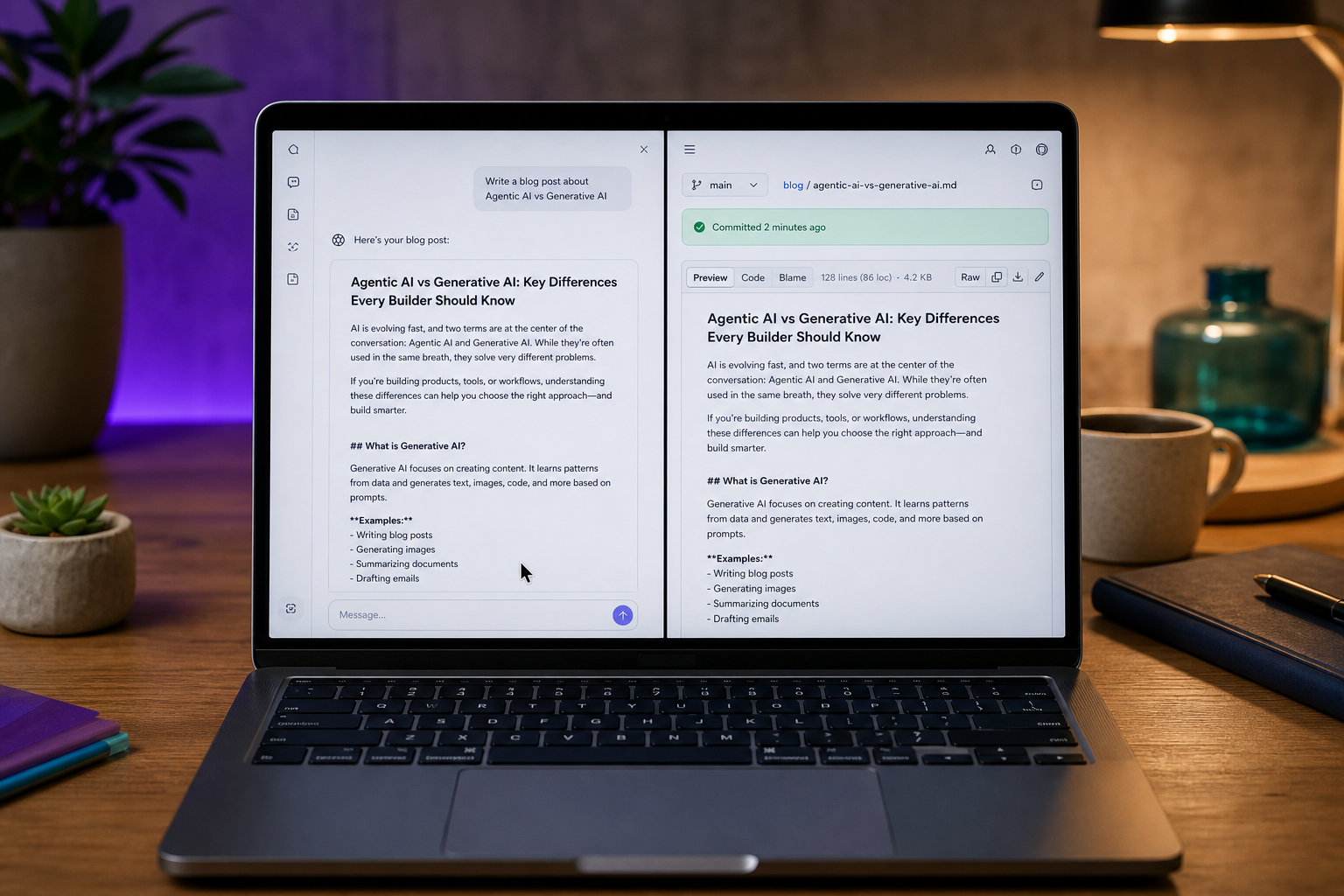
Agents read from and write to external systems: databases, REST APIs, spreadsheets, Git repos, Slack, CRMs. Thomson Reuters defines tight integration with external tools as the core architectural marker of agentic AI. The concrete example: a Blog Writer agent doesn't return markdown for you to paste — it commits the file directly to your GitHub repo. A Lead Hunter agent doesn't return a list of names — it pushes a validated CSV to your sales tool. The deliverable is a file or record, not a chat message.
4. Persistent Memory Across Sessions
Agentic systems maintain state through external stores — databases, vector stores, file systems — so they remember previous outputs, user preferences, and intermediate artifacts. Infor notes this is what enables long-running and recurring workflows. The agent that ran your competitor scan yesterday remembers what it found. The agent that drafted last week's posts knows your house style. Generative AI's memory ends with the context window. Agentic memory ends when you tell it to.
5. Self-Verification and Quality Gates
Agents check their own work against external truth — does the scraped data match the source page, do the lead emails pass validation, did the file actually commit to the right branch — before declaring the task done. IBM and Thomson Reuters both flag this verification step as essential for trusting autonomous execution. Without it, agents drift. With it, they ship.
These five capabilities are the difference between an AI that helps you write and an AI that does the work and hands you the receipt. Drafting is one capability. Decomposition, looping, tool use, memory, and verification are the other four — and they're the four that turn a chat interface into a coworker.

When You Actually Need Agentic AI vs When Generative AI Is Enough
Most builders default to whichever AI they tried first. That's expensive when the task is recurring and frustrating when the task is one-off. The matrix below maps real workflows to the AI type that fits. The framing draws on Databricks and Infor's "action vs output" distinction: generative AI produces content, while agentic AI uses that content to complete tasks toward a goal.
| Task | Generative AI Fits | Agentic AI Fits | Why |
|---|---|---|---|
| Brainstorm 20 campaign angles | ✓ | — | Single-pass ideation, no execution |
| Draft one cold email | ✓ | — | One-shot writing, no tool calls |
| Summarize a 40-page PDF | ✓ | — | Single synthesis pass, output is deliverable |
| Rewrite copy in three tones | ✓ | — | Variant generation, human picks winner |
| Build a 200-lead list with verified emails, export to CRM | — | ✓ | Search + scrape + validate + API write |
| Research five competitors and publish a comparison post | — | ✓ | Multi-source research + draft + publish |
| Monitor competitor pricing daily, Slack on changes | — | ✓ | Continuous execution + integration + alert |
| Generate product descriptions from a spec sheet | ✓ | — | Template fill, one output per row |
| Generate descriptions, push to Shopify, sync inventory | — | ✓ | Tool chaining and state management |
| Draft replies to ten support tickets | ✓ | — | Per-ticket draft, human reviews |
| Triage support inbox, draft replies, route nightly | — | ✓ | Recurring multi-step workflow |
| Review a document for tone and clarity | ✓ | — | Single-pass critique |
Generative AI answers questions. Agentic AI completes tasks — and the difference shows up the second a workflow has more than one step.
The pattern across the matrix: generative AI wins whenever the task ends with "and then a human reads it." Agentic AI wins whenever the task ends with "and then it lives somewhere" — a CRM, a repo, a Shopify catalog, a Slack channel, a published URL.
Three signals tell you the task has crossed into agentic territory:
- Multiple data sources or systems are involved. Anything that requires you to copy data from Tool A into Tool B is a workflow, and workflows are what agents handle. Thomson Reuters frames generative AI as best for discrete, single tasks and agentic AI for complex, chained tasks across systems.
- The task recurs. A one-time brainstorm doesn't justify agent setup. A weekly competitor report does. The payoff structure flips around the 3-to-5-run mark — after that, every run is pure margin against the setup cost.
- Success has a measurable definition. Agents need guardrails: "all emails must validate," "all files must commit to main," "all leads must have a verified domain." If you can't write the success rule, generative AI is the safer choice until you can.
The cost picture matters here too. If you're using generative AI plus an hour of manual copy-paste per task, you're paying for agentic-style work at generative-AI prices in the model — and at expensive prices in your own time. That gap is where platforms in the broader landscape of AI tools builders are evaluating are positioned: flat-rate access to specialized agents that take the workflow all the way to "file delivered," not just "draft returned." VibeCody's six pre-built specialists — Blog Writer, Lead Hunter, Web Scraper, Report Builder, Content Repurposer, Support Drafter — each target one of those recurring, multi-step categories of work.
Inside an Agentic AI Loop — How Autonomous Execution Actually Works
Capability descriptions only get you so far. To understand why agentic AI behaves differently in practice, you have to look at what actually happens when an agent receives a goal — the mechanics underneath the marketing.
The core mechanism is the plan–act–observe–learn loop. IBM and Infor both describe agentic AI as systems that observe, plan, act, and learn in a loop, combining LLMs with tools, APIs, and other services to autonomously pursue a goal. Walk through what each phase does in a real execution:
Goal intake. The user submits a goal in plain English, not a prompt. "Build a lead list of 100 marketing agencies in Austin with verified emails." This is a destination, not an instruction.
Task decomposition. The agent calls its underlying LLM one or two times to plan: what sub-tasks, in what order, using which tools. The output is an internal execution plan, not user-facing text.
Tool invocation. The agent makes N calls to external services — search APIs, scraping endpoints, email validators, CRM write endpoints. Each call has its own authentication, rate limit, payload structure, and error-handling logic. This is where most of the engineering work in an agentic platform actually lives.
Result evaluation. The agent calls the LLM again to check the output. Did the scrape return the right fields? Are there duplicates against the existing list? Do the emails pass validation? Are any companies outside the target geography?
Corrective action. If something fails — rate limit hit, parser returned garbage, validation rate too low — the agent retries with adjusted parameters, picks an alternative tool, or surfaces the issue with context so a human can decide.
Termination. The agent stops when success criteria are met. Not when the user says stop. Not after a fixed number of steps. When the goal is satisfied.
An agent isn't a smarter chatbot. It's a controller loop that calls a chatbot as one of its tools, then keeps going.
This requires far more than a better prompt. Red Hat explicitly notes that generative AI has no native control loop — those have to be engineered externally. Agentic platforms build that orchestration layer: tool schemas, authentication management, rate limiting, retry logic, state persistence, observability. It's an entire infrastructure stack the user never sees.
State management is the other piece that breaks generative AI's model. A generative session is bounded by a fixed token window. Old conversation gets truncated. Agentic systems use external state stores — databases, vector stores, file systems — to persist intermediate results, user preferences, and task history across sessions. Infor highlights this as the prerequisite for recurring jobs. The agent that ran your competitor scan yesterday opens today's run with yesterday's findings already loaded. The Blog Writer that learned your brand voice on post one carries it into post fifty.
The inference cost picture shifts accordingly. Generative AI runs roughly one model call per user request. Agentic AI often runs dozens of model and tool calls per task — plan, search, scrape, summarize, validate, write, update. Token cost and latency scale roughly linearly with steps. But human time per task drops by an order of magnitude. That tradeoff is what makes agentic AI economically interesting; understanding how AI handles multi-step technical workflows is essential to making the call correctly.
Latency expectations differ accordingly. Generative AI returns text in sub-second to a few seconds for most outputs. Agentic AI takes tens of seconds to several minutes per workflow run — but runs unattended and on a schedule. You don't wait for it. You check what it produced.
Here's a concrete walkthrough. A user tells the Blog Writer agent in plain English: "Write a 1,500-word post on remote work tools for small agencies, cite three industry sources, and publish it to my blog repo as a markdown file." The agent plans — outline → research → draft → format → commit. It calls search APIs for sources, drafts the post via its underlying LLM, validates the structure against the requested word count and citation rules, formats as markdown with frontmatter, commits the file to the connected GitHub repository, and returns a confirmation with the commit URL. The user reviews the live file. They never copy-pasted anything. They never opened the model directly. The goal in plain English produced a file in the repo.
The honest limitation: IBM is explicit that agentic AI still relies on probabilistic LLMs underneath, which means hallucination doesn't disappear. It can amplify across multiple steps if verification isn't designed in. An agent that hallucinates a competitor's pricing in step two and uses that fabricated number in steps three through seven has multiplied the error, not contained it. This is exactly why quality gates and human checkpoints matter — and why mature agentic platforms surface intermediate artifacts for review on the steps that carry real consequences.
Speed, Cost, Control, and Privacy — The Real Tradeoffs
No AI architecture is free. Agentic AI buys execution by spending tokens, transparency, and setup time. Generative AI buys speed and simplicity by leaving every workflow step after "draft" to you. Here's what changes in four dimensions.
Speed
Generative AI returns a single output in seconds. The catch: the human has to orchestrate everything around it — paste into the next tool, verify the data, send the email, log the touch. Agentic AI is slower per task. A single workflow run often takes tens of seconds to several minutes. But end-to-end completion time drops dramatically because the human exits the loop. For a recurring workflow run 20-plus times a month, the per-task wallclock comparison is misleading. The relevant number is total human minutes spent across all runs — and that's where agentic AI pulls ahead by an order of magnitude.
Cost Structure
Generative AI is pay-per-call or flat subscription, with predictable, low per-output cost. Agentic AI consumes more tokens per task because each task triggers many model and tool calls. The substitution is human labor cost for token cost — and that math flips fast for high-frequency workflows. Breakeven typically lands around 5-to-10 runs per month for tasks that take a human 20 minutes or more. Flat-rate agent platforms remove the per-task accounting entirely: one subscription, unlimited executions across the agent roster, predictable monthly spend regardless of how many lead lists or blog posts or competitor scans run that month.
Agentic AI trades transparency for throughput — a worthwhile bet when the task is clear, repeatable, and currently eating your week.
Control and Transparency
With generative AI, you control the prompt and own the output. Debugging is straightforward: bad output, change the prompt, try again. With agentic AI, the agent controls execution flow, which can feel opaque if the platform doesn't expose its work. You set guardrails up front, then monitor outputs. Databricks acknowledges agentic AI introduces new infrastructure and oversight complexity — multi-step workflows, state, failure modes, retry behavior. The best practice, per IBM and Thomson Reuters: define explicit approval gates before critical actions like sending mass emails, updating pricing, or committing code to production branches. Surface drafts for review on anything irreversible. Let the agent run unattended on anything that's easy to undo.
Data and Privacy
Generative AI sends every prompt to a model API. Sensitive data crosses that boundary every time you paste it into a chat. Agentic AI can keep more data inside its runtime — pulling from your sources, processing internally, writing outputs directly to your private repos or tools without dumping intermediate content into a chat window. For solopreneurs handling proprietary lead lists, competitor pricing intel, or customer support records, the data-handling pattern is meaningfully different. The agent platform's delivery model — output files going straight to a connected GitHub, GitLab, or Bitbucket repo — is a concrete example of that pattern. Your data lands in your storage, not in a chat history.
The tradeoff isn't "better vs worse." It's "where do you want to spend?" Generative AI spends your time. Agentic AI spends tokens and setup. The right answer depends on how often the task repeats and how much of your week it currently eats.
The Three-Question Test for Picking the Right AI for Your Next Project
Every workflow you're considering automating fits one of two categories. These three questions sort it. Answer honestly — the wrong answer costs you either money on agents you don't need or hours on workflows that should have been handed off months ago.
1. Will you run this task again in the next 30 days?
- Yes → Agentic AI candidate. Even three runs at 20 minutes each justifies setup.
- No → Generative AI is the right call. Don't build infrastructure for a one-off.
The rule of thumb behind this: setup time for an agent is real. Maybe 30 to 60 minutes of describing the task, defining success criteria, and testing the first run. That cost amortizes across runs. One run can't carry it. Twelve runs barely notice it.
2. Does the task touch more than one system or data source?
- Yes → Agentic AI. Anything that requires you to move data from Tool A into Tool B, or verify content against an external source, is a workflow.
- No → Generative AI handles it. Single-source tasks like "rewrite this paragraph" or "draft this email from these notes" don't need orchestration.
Thomson Reuters' distinction holds here: generative AI for discrete tasks, agentic AI for chained tasks across systems. If you can describe the task without naming a second tool, you probably don't need an agent.
3. Can you write a one-sentence rule for what "done correctly" means?
- Yes → Agentic AI has the guardrail it needs. "All emails must validate." "All leads must have a verified company domain." "The post must be committed to the
/postsdirectory with valid frontmatter." - No → Stay with generative AI until the success criteria sharpen. Agents without success rules drift, loop, or finish wrong.
Go / No-Go Framework
Use generative AI for: one-off writing, brainstorming, summarization, draft feedback, tone rewriting, ad-hoc translation, exploratory research where you want to read everything yourself before deciding what matters.
Use agentic AI for: lead generation pipelines, recurring content publishing, competitor monitoring, bulk data transformation, support ticket triage, scheduled report generation — anything that ends with a file or record landing in a system you own.
Use a hybrid approach for: workflows where ideation is human and execution is agentic. You brainstorm the angle; the Blog Writer agent researches, drafts, formats, and publishes. You decide the prospect criteria; the Lead Hunter agent finds, validates, and exports. The pattern is consistent — humans set direction, agents handle the grind.
Look at your last five repetitive tasks. For each, ask: did it end with "human review plus manual integration," or "file delivered to tool"? Every task in the first category is an agent waiting to be hired. The six VibeCody specialists — Blog Writer, Web Scraper, Lead Hunter, Report Builder, Content Repurposer, Support Drafter — are each tuned to one of the most common categories of work that should never have been manual in the first place. The question isn't whether you need agentic AI eventually. It's which of those five tasks you're going to keep doing by hand next week.